
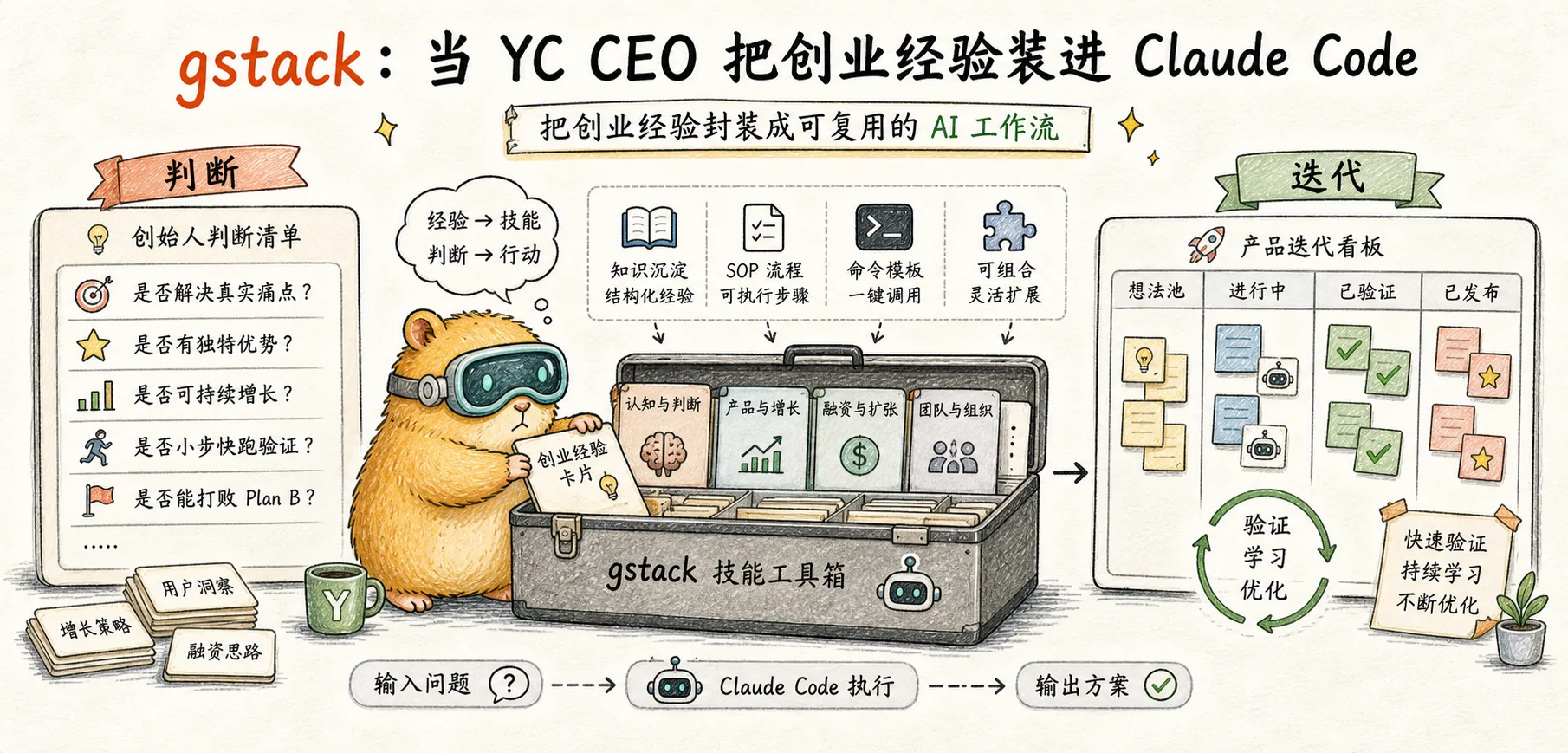
gstack: When YC CEO puts entrepreneurial experience into Claude Code
Garry Tan What is the open source gstack, what problems does it solve, core workflow and tool ecological positioning
Introduction
In previous notes, we explored various "enhancement solutions" in the Claude Code ecosystem from the infinite loop of Ralph Wiggum to the specification-driven development of GSD. They are all trying to answer the same question: **How to change AI programming from "adaptation" to "reliable delivery"? **
Ralph's answer is "restart everything" - use a new process each time to avoid context rot. GSD's answer is "Specification Driven" - ensuring quality through structured phase planning and validation cycles. But what if you want not just an execution system, but a complete virtual engineering team? The CEO makes product decisions, the engineering manager reviews the architecture, the designer controls the experience, the QA runs real browser tests, and the release engineer manages the launch...all are played by AI and are commanded by you.
This is the core idea of gstack.
What is gstack
Created by Y Combinator CEO Garry Tan, the open-source role-based skill set contains 23+ Slash Commands, transforming Claude Code from a single AI assistant into a virtual engineering team. Each skill corresponds to a professional role - CEO, engineering manager, designer, QA Lead, security officer, release engineer - giving AI different thinking modes and professional perspectives.
Garry Tan, the creator of gstack, has a rich technical and entrepreneurial background - he started writing code at the age of 14, graduated from Stanford Computer Engineering, is the 10th employee of Palantir, co-founded Posterous (later acquired by Twitter), and has served as President & CEO of Y Combinator since 2023.
He used gstack to release more than 600,000 lines of production code (35% testing) in 60 days, averaging more than 10,000 lines per day - while still running YC full-time. One of the projects, garylist.org, was launched in 21 days, with 150,000 lines of code and 35% test coverage. According to his own words, the code quality exceeds the previous entrepreneurial project he spent $5 million, two years, and 10 engineers on.
Since the project was open sourced on March 11, 2026, it iterated from v0 to v0.15.1.0 within 3 weeks, and GitHub has received 60,500+ stars. MIT license, completely open source.
gstack - Claude Code Skills
23+ opinionated skills that transform Claude Code from a single AI assistant into a virtual engineering team.
The position of gstack in the tool ecosystem
| Dimensions | Native Claude Code | Ralph Wiggum | GSD | SpecKit | Superpowers | gstack |
|---|---|---|---|---|---|---|
| Core Positioning | Universal AI Coding Assistant | Infinite Loop Iteration | Contextual Engineering + Specification Driven | Requirements → Specifications → Tasks | Process Discipline + TDD | Role-Based Virtual Team |
| Core Pattern | Conversational Programming | Bash Loop + New Process | Phase-based Roadmap | Spec → Plan → Tasks | Strict Development Pipeline | Sprint Seven-Step Process |
| Human involvement | Live conversations | Hands-off (AFK) | Verification per stage | Spec approval | Validation per step | Role review per stage |
| Unique capabilities | Basic coding | Unlimited iteration | Context Rot management | Requirements tracing | Forced TDD | Browser automation + multi-role review |
| Suitable for scenarios | Simple tasks | Continuous iteration | Large-scale project management | Projects with rigorous requirements | Engineering quality assurance | Full-process product development |
A key pattern can be seen from the table: **These tools do not compete with each other, but solve AI programming problems in different dimensions. **
Superpowers uses process discipline to ensure code quality (mandatory TDD, structured dialogue, implementation plan); GSD uses context engineering to manage complex projects (phase planning, sub-agent fresh context, file system status); gstack uses role decomposition to improve decision-making quality (CEO perspective reviews products, engineering managers review architecture, QA runs real browsers).
To put it simply, Superpowers is based on process guardrails, and gstack is based on role design—the former is suitable for project implementation from 1 to N, and the latter is suitable for product construction from 0 to 1. **The two are complementary rather than competing products. **
Core workflow: The Sprint seven steps
gstack organizes the entire development process into a cycle of Think → Plan → Build → Review → Test → Ship → Reflect, called "The Sprint" - not an agile Sprint, but a development rhythm of "roles appear in sequence".
1. Think — Product Clinic
/office-hoursThis is the most distinctive skill of gstack. The inspiration comes directly from YC’s Office Hours – entrepreneurs go to meet YC partners and undergo soul-searching. The AI will ask you 6 forcing questions:
- Who specifically needs this?
- What if they don’t have it today?
- Why is this matter urgent now?
- How do you know it works?
- What happens if you do nothing?
- What is the smallest version you can release?
The purpose is not to help you write code, but to re-examine the problem itself before writing code.
2. Plan — Multi-role review
/plan-ceo-review    # CEO 视角:寻找 10 星级产品
/plan-eng-review    # 工程经理:锁定架构和边界
/plan-design-review # 设计师:评分 0-10,说明如何做到 10 分
/autoplan           # 自动依次运行三个审查
CEO Review is essentially "Founder Mode" - instead of executing requirements literally, you step back and ask "What is the true purpose of this product?" It supports four modes: Expand Scope, Selective Expand, Maintain Scope, and Reduce Scope.
3. Build — coding implementation
Start coding according to the approved plan. This step uses standard Claude Code capabilities.
4. Review — Parallel expert review
/reviewThis skill dispatches 7 parallel sub-agents at one time to review the code from 7 perspectives: testing, maintainability, security, performance, data migration, API contract, and red team attack. Obvious problems will be automatically fixed.
5. Test — Real browser QA
/qaNot a practice test. The QA skill launches a real headless Chromium browser, opens your app, clicks buttons, fills out forms, and takes screenshots - just like a real tester would. Automatically fix bugs, generate regression tests, and re-verify after bugs are discovered.
6. Ship — one-click publishing
/shipAutomatically sync the master branch, run tests, review diffs, update version numbers and CHANGELOG, commit, push, create PRs. If the project doesn't have a testing framework, it will even build one first.
7. Reflect — review and learn
/retroEngineering manager-style weekly report: analyze commit history, test ratio, and code quality trends. Support multi-person team analysis and track indicators such as "number of consecutive release days".
Why it works: Technical principles
Browse Daemon: Put eyes on AI
gstack's most unique technical contribution is the Browse Daemon - a persistent headless Chromium instance that communicates over localhost HTTP. The first call launches the browser (~3 seconds), and each subsequent command takes only 100-200ms. This means that the AI can actually see your app, rather than guessing the DOM structure.
It also introduces Ref System (element reference @e1, @e2) to locate elements through the accessibility tree without writing CSS selectors. This is a "truly technical contribution" that is generally recognized by the community (including critics).
Role breakdown: not an agent, but a team
What gstack does is to disassemble all roles into independent prompt files, allowing Claude Code to switch to the perspectives of different roles at different stages to review the code. This is essentially a refined prompt engineering.
The core insight is: **Planning does not equal review, review does not equal release, and founder taste and engineering rigor are completely different modes of thinking. ** Instead of having a general agent do everything, switch "brain modes" when needed - founder thinking, engineering rigor, paranoid review, fast execution.
Three major philosophies
gstack's ETHOS.md records three core concepts:
-
Boil the Lake: When AI drives the marginal cost of completeness to zero, always choose a complete implementation - 100% test coverage, all edge cases, all error paths. "Release shortcuts" are old-time thinking.
-
Search Before Building: Three layers of knowledge - time-tested patterns, new and popular solutions, and first principles. Start by understanding what everyone is doing, questioning their assumptions, and discovering why the usual solutions are wrong.
-
User Sovereignty: AI recommendation, human decision-making. Even if two AI models reach consensus, the user’s judgment still takes precedence—because the user has domain knowledge, strategic perspective, and taste.
The boundaries and controversies of gstack
Community reaction to gstack is probably the most polarizing of any AI programming tool.
The bright side: Founders and non-technical builders generally agree, especially "product thinking" skills like /office-hours and /plan-ceo-review, have helped many independent developers re-examine the product direction before starting to code. Engineering review (/review) can indeed discover some hidden security vulnerabilities. This multi-angle parallel review model has practical value.
The questioning side is also very direct:
- LOC indicator is of little significance: 600,000 lines of code in 60 days. The number of lines of code is never a quality indicator. A large amount of code may be just scaffolding and boilerplate.
- Essentially a prompt template: Each skill is a SKILL.md file, and the technical threshold is not high. The real value is not in the file itself, but in the quality of the prompt's design.
- Limitations of AI self-review code:
/reviewLetting AI review the code written by AI is equivalent to correcting your own homework. Multi-role parallelism can alleviate this problem, but it is still the same model. - Celebrity effect bonus: If the founder is not the YC CEO, there is a high probability that this project will not receive such high attention.
My opinion: Controversies aside, the really valuable parts of gstack are two--the browser automation technology of Browse Daemon, and the design pattern of role decomposition. None of this depends on who Garry Tan is. The core significance of roleization is not at the technical level, but at the behavioral level - it helps you organize your AI workflow more consciously, rather than throwing everything at a general agent.
gstack is suitable for forking and customizing. You can get the skills you need and change the prompts you want, rather than copying them all.
Video resources
Write at the end
gstack represents an interesting direction for AI programming tools: not to make AI more autonomous (Ralph's route), nor to make the process more rigid (Superpowers' route), but to let AI play different roles to improve the quality of decisions. Its controversy just illustrates the richness of the AI programming ecosystem—no one solution fits everyone.
If you are interested in gstack, the next step is to read Practical Chapter - a step-by-step tutorial from installation to running through the complete workflow.
Related Reading:
- Introduction to GSD concepts — Another structured AI programming solution
- Ralph Wiggum in-depth analysis — Understand the starting point of infinite loop iteration
- Claude Skills Concept — Understand the underlying mechanism of Skills