
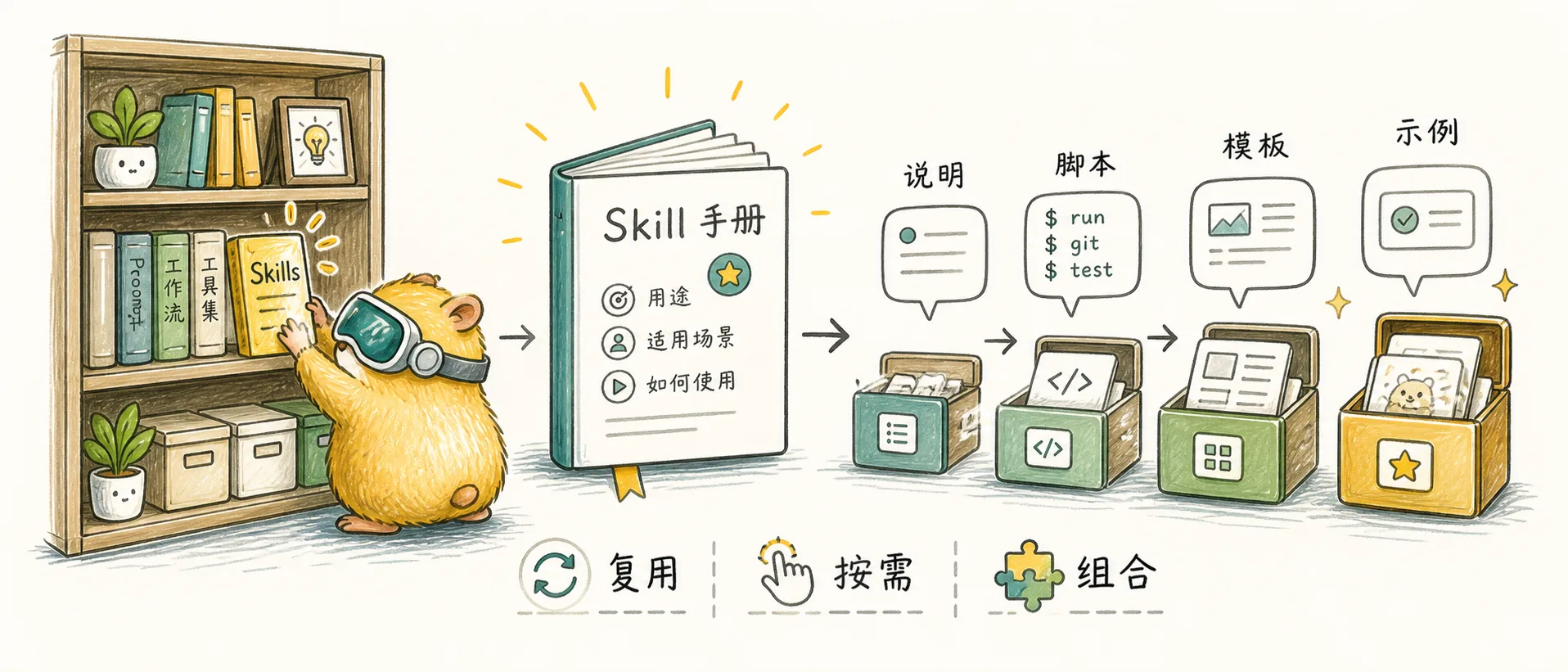
Concept Introduction
A deep dive into the core principles of Claude Skills: how reusable AI playbooks achieve token efficiency and composability through progressive disclosure
Introduction
Claude Skills are awesome, maybe a bigger deal than MCP... I expect we'll see a Cambrian explosion in Skills which will make this year's MCP rush look pedestrian by comparison.
In October 2025, Anthropic quietly released a new feature called Claude Skills. Despite its understated debut, prominent tech blogger Simon Willison called it "maybe a bigger deal than MCP" and predicted it would trigger a "Cambrian explosion" in the AI tooling space.
This assessment is far from hyperbole. If you use AI assistants regularly, you have likely encountered a familiar frustration: every new conversation requires you to re-enter the same workflow instructions; you finally get the AI tuned to your satisfaction, only to start from scratch in a new chat window. Skills were built to solve exactly this pain point.
Understanding Claude Skills
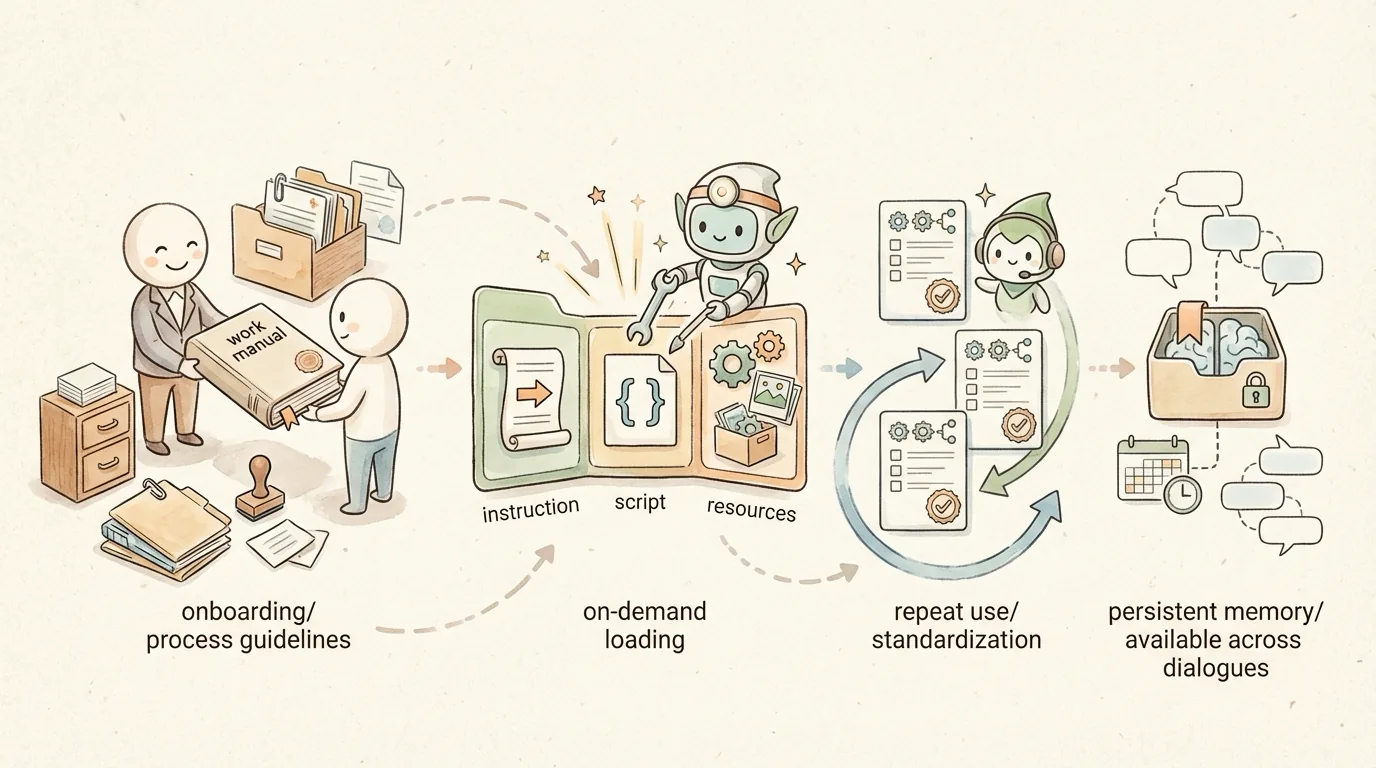
Imagine you are a company owner handing new employees an operations manual that documents workflows, brand guidelines, and standard procedures for handling common issues. Claude Skills is essentially that "operations manual" for an AI assistant -- enabling it to complete specific tasks in a repeatable, standardized way.
From a technical perspective, Skills are folders containing instructions, scripts, and resources that Claude can dynamically load on demand. Each Skill teaches Claude how to handle a particular type of task consistently, and this knowledge persists across conversations. This means you only need to "train" it once -- from then on, Claude will remember how to do it no matter when you use it.
Three Core Components
A complete Skill consists of three parts:
| Component | Purpose | Required |
|---|---|---|
| SKILL.md | Core instruction document containing metadata and detailed instructions | Required |
| Reference Materials | Brand guidelines, policy documents, templates, and other supplementary information | Optional |
| Scripts | Python/JavaScript code for complex computations or file operations | Optional |
SKILL.md is the "soul" of the entire Skill. Its basic structure looks like this:
---
name: your-skill-name
description: Brief description of what this Skill does and when to use it
---

# Your Skill Name

## Instructions
Provide clear, step-by-step guidance for Claude.

## Examples
Show concrete examples of using this Skill.

## Guidelines
- Guideline 1
- Guideline 2
The YAML frontmatter at the top of the file contains two key fields: name is the Skill's identifier, limited to 64 characters; description tells Claude what the Skill does and when to use it, limited to 200 characters. Claude uses this description to determine when to invoke a given Skill, so the clearer and more accurate it is, the higher the probability that the Skill will be triggered correctly.
Use Cases
Skills cover a wide range of applications across everyday repetitive tasks:
Document Generation: Batch-create Excel spreadsheets, PowerPoint presentations, Word documents, and PDF reports. Anthropic even provides an official set of document Skills that work out of the box.
Brand Compliance: Package your company's brand colors, logo usage rules, spacing guidelines, and tone of voice into a Skill, ensuring that all AI-generated content adheres to brand standards.
Meeting Notes: Automatically summarize meeting recordings, extract action items, assign owners, and generate follow-up emails.
Data Analysis: Execute standardized analysis workflows, such as competitive intelligence scanning (structured extraction of product updates, pricing changes, and analyst commentary) or financial analysis (analyzing earnings reports and building financial models).
Project Management: Build project plans from objectives, suggest milestones, and generate weekly reports or investor briefs.
Progressive Disclosure Architecture
The most elegant aspect of Skills is how information is loaded. Traditional MCP tool descriptions can consume thousands or even tens of thousands of tokens, while Skills metadata takes up only a few dozen tokens. This means you can enable a large number of Skills simultaneously without worrying about tool descriptions filling up the context window.
This efficiency stems from an architectural pattern called Progressive Disclosure. Skills use a three-layer information structure that loads content on demand -- much like a manual with a table of contents:
📚 Skills Playbook
│
├─ 📋 Table of Contents ──────────────── [Metadata Layer] Preloaded at startup
│   │
│   │  name: "weekly-report"
│   │  description: "Generate standardized weekly reports from work content"
│   │
│   │  ✓ Only 30-50 tokens
│   │  ✓ All Skills' metadata visible at once
│   │
│
├─ 📖 Chapters ────────────────────────── [Core Document Layer] Loaded when relevant
│   │
│   │  # Weekly Report Generator
│   │
│   │  ## Instructions
│   │  Generate weekly reports following this structure...
│   │
│   │  ## Examples
│   │  Input: Completed the login feature this week...
│   │  Output: ### Completed This Week ...
│   │
│   │  ⚡ Expanded only when Claude determines it's needed
│   │  📊 Consumes hundreds to thousands of tokens
│   │
│
└─ 📎 Appendix ────────────────────────── [Reference Resource Layer] Loaded when needed
    │
    │  references/
    │  ├── brand-guide.md      Brand guidelines
    │  ├── template.xlsx       Report template
    │  └── examples/           Past reports
    │
    │  🔍 Loaded only when explicitly needed
    │  📦 Can contain extensive reference materials
You first scan the table of contents to see what chapters are available (metadata layer), then open the relevant chapter to read it (core document layer), and finally consult the appendix if you need more details (reference resource layer).
| Layer | Content | When Loaded | Token Cost |
|---|---|---|---|
| Metadata Layer | name + description | Preloaded at startup | 30-50 |
| Core Document Layer | Full SKILL.md content | Loaded when relevant | Hundreds to thousands |
| Reference Resource Layer | Reference files, templates, etc. | Loaded when needed | On demand |
This aligns perfectly with the fundamental nature of large language models -- "feed text to the model so it understands." Skills do not introduce complex protocols or API calls; instead, they use carefully organized text structures to help AI efficiently acquire and apply knowledge. Simon Willison described this design as "absurdly elegant," precisely because it solves a complex problem in the most straightforward way possible.
Core Advantages
Token Efficiency
The progressive disclosure architecture of Skills delivers exceptional token efficiency. A simple comparison illustrates the difference:
| Approach | Tokens at Startup | Total for 100 Skills |
|---|---|---|
| Traditional (full load) | Thousands to tens of thousands | May exceed context window |
| Skills (progressive disclosure) | 30-50 | 3,000-5,000 |
Since each Skill's metadata occupies only a few dozen tokens, you can enable dozens or even hundreds of Skills simultaneously, with full content loaded on demand -- never wasting precious context space.
Composability
Multiple Skills can work together automatically. When you present a complex task, Claude intelligently identifies which Skills to invoke and coordinates them to complete the task.
For example, if you say "Generate a quarterly report from this sales data," Claude might:
- Invoke a data analysis Skill to process the raw data
- Invoke a chart generation Skill to create visualizations
- Invoke a document Skill to produce the final report
Throughout this process, you never need to manually specify which Skill to use -- Claude automatically selects and combines them based on the task requirements.
Portability
The same Skill works across all platforms in the Anthropic ecosystem:
| Platform | Description |
|---|---|
| Claude.ai | Web interface, suited for general users |
| Claude Code | CLI tool, suited for developers |
| API | Programmatic integration, suited for system development |
A brand writing Skill you create for your team will behave consistently across all these platforms, truly achieving build once, use anywhere.
Other AI Platforms' Strategies: Skills is currently an Anthropic-exclusive feature. OpenAI uses a dual-track approach with Custom GPTs + Assistants API (two systems that are not unified); Microsoft Copilot and Google Gemini focus on deep integration within their respective ecosystems rather than reusable skill modules. Claude Skills is considered a meaningful differentiator.
Efficiency Data
According to Anthropic's internal benchmarks, teams using Skills reduced repetitive prompt engineering time by 73%. This is not just about efficiency gains -- more importantly, it represents the standardization and reusability of workflows. Team members no longer need to maintain their own sets of prompts; instead, they share a single set of verified Skills.
Summary
At its core, Claude Skills are reusable playbooks for AI assistants. Through progressive disclosure architecture, they achieve exceptional token efficiency, enabling AI to master extensive domain knowledge without consuming precious context space.
Remember three key concepts, and you will have grasped the essence of Skills:
| Concept | Meaning |
|---|---|
| Efficient | Metadata occupies only a few dozen tokens; content loads on demand |
| Composable | Multiple Skills work together automatically |
| Portable | Consistent experience across platforms |
Now that you understand the concepts, the next article, Claude Skills Practical Guide, will walk you through hands-on practice: how to enable and install Skills, create your first custom Skill, and avoid common pitfalls.
If you want to further formalize your workflows, check out What Is Spec-Driven Development to learn how to elevate AI programming from "intuition" to "engineering."
Comments
The Complete Guide to Claude Agent Teams
Master Claude Code's Agent Teams feature - coordinate multiple Claude instances into a team for true multi-agent collaborative development
Practical Guide
Create custom Skills from scratch — compare MCP, Subagents, and more, and master best practices for enabling, installing, and creating Skills