
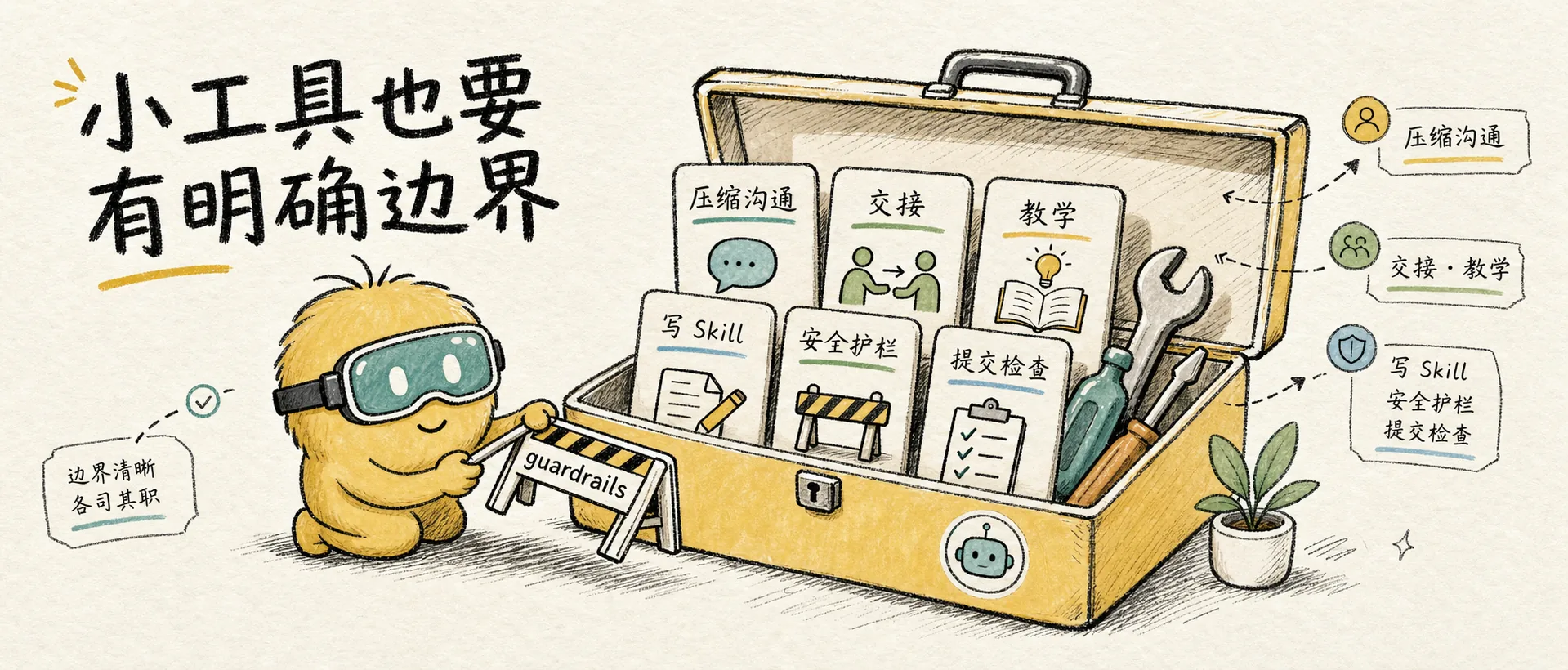
Other Skills: Compressed Communication, Handoff, Teaching, Writing Skills, and Safety Guardrails
A summary of non-mainline but useful tools from mattpocock/skills: caveman, handoff, teach, write-a-skill, as well as git guardrails, setup-pre-commit, migrate-to-shoehorn, scaffold-exercises.
Why not elaborate on each one
Matt's README categorizes skills into three types:
- Engineering: For writing real code daily
- Productivity: General workflow tools
- Misc: Small tools he keeps for personal use
The previous articles have covered the main engineering skills. This article combines the remaining productivity and misc skills because most of them are not full development processes, but rather small, useful switches for specific scenarios.
If you're only installing 5, I still recommend prioritizing:
But if you've already got the main skills running, the following will make your daily experience smoother.
Productivity Skills
caveman: Extreme Communication Compression
/caveman is a "low token mode." It asks the agent to remove pleasantries, filler words, over-explanation, and vague buffering, retaining only technical information.
It's suitable when:
- You're iterating frequently and don't want to read long responses
- Debugging and only need facts, reasons, and next steps
- Long contexts are almost full, and output needs to be compressed
- You want to force the AI to be less verbose
It doesn't make the AI rude, but rather makes it use shorter syntax while retaining full technical precision. Note that it remains active until you explicitly exit it.
I would treat it as a temporary setting, not a long-term default. For high-risk operations, safety warnings, and complex multi-step instructions, being too brief can lead to misinterpretation.
handoff: Handing off the current conversation to the next agent
The goal of /handoff is to compress the current conversation into a handoff document and save it to the system's temporary directory, rather than polluting the current workspace.
It will include:
- Current goals
- Decisions made
- Key paths and files
- Remaining tasks
- Suggestions for which skills the next agent should call
- Redacted sensitive information
It's especially suitable when a long task is interrupted, the context is almost full, or you want to switch to a different agent.
The key point is: do not duplicate content already present in PRDs, issues, ADRs, commits, or diffs; only reference paths or URLs. The value of a handoff document is to fill in the state scattered across the conversation, not to recreate project documentation.
teach: Turning the current directory into a learning workspace
/teach is the heaviest of this group. It treats the current directory as a long-term learning workspace, maintaining:
MISSION.md: Why you are learning this topicRESOURCES.md: A list of high-quality resourceslearning-records/*.md: Learning records, similar to ADRslessons/*.html: Interactive lessons, one per sessionreference/*.html: Quick reference materialsNOTES.md: Teaching preferences and work notes
Its highlight is treating learning as a long-term system, not a one-off Q&A. It particularly emphasizes:
- Mission first: Why you learn is more important than what you learn
- Retrieval practice: Using recall exercises to build long-term memory
- Spacing / interleaving: Don't be fooled by short-term fluency
- High-trust resources: Find resources first, don't rely solely on the model's memory
If you're just asking "explain X," you don't need it; if you want to study a topic for several weeks, it's very suitable.
write-a-skill: Scaffolding for writing new skills
/write-a-skill is Matt's abstraction of the skill structure itself.
It requires a skill to have at least:
skill-name/
├── SKILL.md
├── REFERENCE.md
├── EXAMPLES.md
└── scripts/
Of course, the latter three are not mandatory and are only added when the content is too long, examples are valuable, or operations can be scripted.
Its most important judgment is: description is the only information the agent sees first when deciding whether to load a skill. Therefore, the description cannot be vague like "helps process documents"; it must state:
- What capabilities it provides
- When it should be triggered
- What the trigger words or context are
This aligns with my own experience writing skills: many skills fail not because the main body is poorly written, but because the description is too generic, and the agent doesn't know it should load it.
Misc Skills
git-guardrails-claude-code: Blocking dangerous git commands
This skill equips Claude Code with a PreToolUse hook to intercept dangerous git commands before executing Bash.
By default, it blocks:
git pushgit reset --hardgit clean -f/git clean -fdgit branch -Dgit checkout ./git restore .
Its value is direct: preventing the agent from pushing, hard resetting, or cleaning untracked files without your authorization.
If you frequently let AI work in real repositories, this skill is well worth installing. It's not about distrusting AI, but about intercepting highly destructive operations at the tool layer, rather than relying on prompts.
setup-pre-commit: Adding pre-commit checks to a project
/setup-pre-commit will set up:
- Husky pre-commit hook
- lint-staged + Prettier
- typecheck
- test
It will first detect the package manager, then decide what to run in the pre-commit hook based on the project's existing scripts. If typecheck or test are not present, it won't create them but will omit them and inform you.
The value of this skill is not in the configuration itself, but in Matt's quality philosophy: don't just let the AI say the code is fine; make it pass deterministic checks.
migrate-to-shoehorn: Reducing as in tests
This is a very Total TypeScript-style small tool. It migrates TypeScript as type assertions in tests to @total-typescript/shoehorn.
Typical replacements:
| Old Way | New Way | Scenario |
|---|---|---|
obj as Request | fromPartial(obj) | Only interested in a few fields of a large object in tests |
obj as unknown as Request | fromAny(obj) | Intentionally passing wrong types to test error paths |
| Complete object mock data | fromExact(obj) | Requires enforcing a complete shape |
It is explicitly for test code, not production code.
This skill is narrow, but it aligns with Matt's engineering taste: don't create 20 meaningless fields in tests for the sake of the type system, and don't completely turn off type safety with bare as.
scaffold-exercises: Generating exercise directories for course repositories
This skill clearly comes from Matt's own course creation workflow. It creates directories according to specifications:
exercises/
└── 05-memory-skill-building/
    └── 05.02-short-term-memory/
        ├── explainer/
        ├── problem/
        └── solution/
Each subdirectory must have a non-empty readme.md, main.ts if necessary, and must pass pnpm ai-hero-cli internal lint.
It's not useful for most engineering projects, but it's very practical for courses, bootcamps, and exercise repositories. More importantly, it demonstrates a characteristic of a good skill: delegating repetitive, mechanical, and detail-prone formatting work to the agent.
Directories not recommended for the main line at present
The upstream repository also contains deprecated/, in-progress/, and personal/.
I suggest not writing them into formal usage guides for now:
| Directory | Why not include in the main line |
|---|---|
deprecated/ | Deprecated, easily misleads readers into adopting old processes |
in-progress/ | Still experimental, behavior and naming may change |
personal/ | More like Matt's private workspace, not necessarily suitable for general readers |
If they are to be written about in the future, a separate article on "Matt Pocock skills repository archaeology" could be made, rather than mixing them with stable recommendations.
Commonalities of this set of small tools
These skills may seem scattered, but they share a common principle:
Turn things that agents tend to drift on into small, well-defined work patterns.
cavemanprevents communication drifthandoffprevents context lossteachprevents learning from becoming a one-off Q&Awrite-a-skillprevents ad-hoc skill structuresgit-guardrailsprevents dangerous commands from relying on self-awarenesssetup-pre-commitprevents quality checks from relying on AI's self-descriptionmigrate-to-shoehornprevents test type assertions from getting out of controlscaffold-exercisesprevents manual omissions in course structures
This is also the most valuable aspect of Matt's repository to learn from: skills don't need to be grand. A small, frequent deviation, if it can be consistently corrected by 20 lines of instructions, is worth writing as a skill.
References
caveman Source File
极限压缩沟通模式,减少 token 和废话。
handoff Source File
把当前对话压缩成下一个 agent 可接手的交接文档。
write-a-skill Source File
按正确结构和渐进披露原则创建新的 agent skill。
teach Source File
在一个有状态的学习工作区里持续教授新技能或新概念。
git-guardrails-claude-code Source File
配置 Claude Code hook,拦截危险 git 命令。
setup-pre-commit Source File
为项目配置 Husky、lint-staged、Prettier、类型检查和测试的提交前检查。
migrate-to-shoehorn Source File
把测试文件里的 TypeScript `as` 断言迁移到 @total-typescript/shoehorn。
scaffold-exercises Source File
按课程仓库规范生成练习目录结构,并通过课程 lint。