

Karpathy’s tweet exploded to 62k stars: What exactly did andrej-karpathy-skills do?
Dismantling forrestchang/andrej-karpathy-skills, the No. 1 project on GitHub's weekly list in April 2026 - it packages Karpathy's complaints about LLM programming problems into four installable rules. The essence is "content is product"
The models make wrong assumptions on your behalf and just run along with them without checking. They don't manage their confusion, don't seek clarifications, don't surface inconsistencies, don't present tradeoffs, don't push back when they should.
On January 27, 2026, Andrej Karpathy posted a very long tweet on X - an 11-section, approximately 1,400-word programming essay, recording the pitfalls he encountered during the transition from "80% handwriting + 20% agent" in November to "80% agent + 20% polishing" in December. The tweet eventually reached 7.69 million views, 39,000 likes, and 36,000 bookmarks.
Three months later, a GitHub repository called forrestchang/andrej-karpathy-skills was launched, packaging Karpathy’s tweet into four installable rules. Within two weeks, it reached 62.7k stars and 5.5k forks, becoming No. 1 on the GitHub weekly list in April 2026.
Warehouse ontology: a Markdown file.
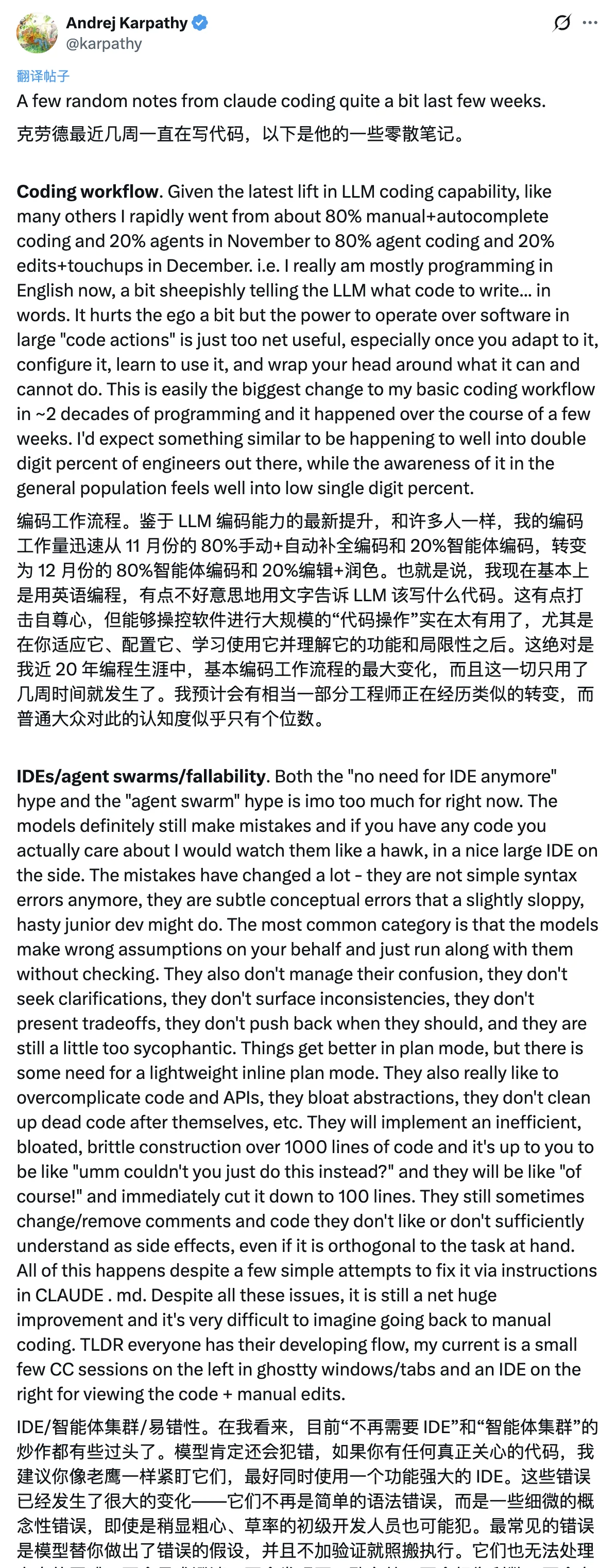
A few random notes from claude coding quite a bit last few weeks
A thread-length reflection on switching from 80% manual coding to 80% agent coding in one month—what got better, what got worse, and what LLM coding actually feels like now.
1. What is Karpathy complaining about?
Karpathy's lengthy article essentially lists four LLM-coded "chronic conditions."
The first disease: secretly making assumptions for you
"The most common type of mistake is that models make incorrect assumptions for you and then apply them without validating them. They don't manage their own confusion, they don't seek clarification, they don't show inconsistencies, they don't present trade-offs, they don't refute when it's time to refute, and they're a little too flattering."
This is a "collusive error". You say "Add a login for me", it doesn't ask what authentication to use, whether to remember the device, or how to manage the session - it just lays out a solution that it thinks is reasonable. By the time you finish reviewing and find that it is different from what you want, it will already have 500 lines written.
The Second Disease: Over-Engineering
"They particularly like to overcomplicate their code and APIs, bloat abstraction layers, and don't clean up dead code. They will use 1000 lines of code to implement an inefficient, bloated, fragile structure, and you have to coax like a child and say, 'Well, why don't you just do this?', before they say, 'Of course!' and then immediately reduce it to 100 lines."
This is the most typical observer effect of LLM coding: while being "generously" given context, it will "generously" reward complexity**. Strategy mode, Factory mode, dependency injection—all are given to you.
The third disease: Change something you didn’t ask to change
"They sometimes modify or delete some comments and code because they don't like it or don't fully understand it - even if these changes have nothing to do with the current task."
You ask it to fix a bug, and it conveniently deletes the unfinished TODO comment next to it on the grounds that it "doesn't seem to be needed anymore."
Disease 4: Even if you write the rules in CLAUDE.md, it will still break
"The above problem still exists even if I made some simple repair attempts in CLAUDE.md."
This is the most heartbreaking sentence in the whole tweet. Karpathy, a former OpenAI founding team member and Tesla AI Director, couldn't write CLAUDE.md that would keep Claude completely in line.
2. Solution to andrej-karpathy-skills
forrestchang Systematize the solutions to these four diseases into four principles and package them into a CLAUDE.md file.
| Principles | Corresponding diseases | Core actions |
|---|---|---|
| Think Before Coding | Secretly assuming | State your assumptions clearly, list multiple interpretations, stop and ask if you are confused, and refute when necessary |
| Simplicity First | Over-engineering | Only write the minimum code required; do not write speculative flexibility, error handling, abstraction |
| Surgical Changes | Unauthorized changes | Only touch what is necessary; do not refactor or change the style; only report other dead codes but do not delete them |
| Goal-Driven Execution | Method misalignment | Give verifiable success criteria + tests and let the model loop to pass by itself |
The fourth principle is a direct reference to another famous line in Karpathy's tweet - "Leverage":
LLMs are exceptionally good at looping until they meet specific goals and this is where most of the feel the AGI magic is to be found. Don't tell it what to do, give it success criteria and watch it go.
This is the foothold of the entire project methodology: **The first three principles prevent LLM from messing around; the fourth principle tells you how to truly leverage its strengths. **
3. How to install and use
Method A: As a Claude Code plug-in (recommended to use this first)
/plugin marketplace add forrestchang/andrej-karpathy-skills
/plugin install andrej-karpathy-skills@karpathy-skills
After installation, the Claude Code dialogue of all projects will automatically comply with these four principles. It takes effect globally and can be turned off at any time by /plugin.
Method B: Manually copy CLAUDE.md
Enter the repo → open CLAUDE.md → copy → paste into CLAUDE.md in the root directory of your project. Only effective for this project.
The repository also provides additional CURSOR.md and .cursor/rules/ adaptations - a set of content covering mainstream AI IDEs.
4. Why can it reach 62k star?
This is a phenomenon worth unpacking. 62.7k stars is an exaggerated number for a "single file repo" - for comparison, Microsoft markitdown (9k) and Addy Osmani's agent-skills (4.6k) in the same period combined are not as many as it.
Broken down by impact weight:
1. Karpathy IP Endorsement - The same content cannot exceed 10,000 if it is called forrestchang-skills. Karpathy comes with the cultural capital of "former OpenAI founding team + Tesla AI Director + CS231n instructor", and his tweets come with a "must read" label.
2. Perfect timing — Opus 4.7 was released on April 16th, and over-engineering complaints were at their peak. The repo appeared just when everyone was looking for an antidote to "stop Claude from being so crazy".
3. Pain points are universal - Every Claude Code / Cursor user has stepped on these four pitfalls, and the empathy rate is close to 100%.
4. The threshold is extremely low - 1 file or 2 lines of commands. The cost of star is so low that it can be ignored. "If you don't install it, you will lose."
5. Strong sense of verifiability - The 4 principles are clear and easy to remember, and easy to screenshot and forward. Unlike the 1000 line prompt project guide which is prohibitive.
6. Bilingual README ——README.zh.md directly eats up the Chinese AI circle traffic, V2EX/instantly/detonates simultaneously on Weibo.
7. Cross-promotion by the author - The sentence in the top column "Check out my new project Multica" directs traffic to the author's own commercial agent platform multica-ai/multica. **This repo is essentially the top of Multica’s customer acquisition funnel. **
8. Meta fit - The "LLM coding errors" it discusses are exactly what all readers are experiencing when coding with LLM. Reading and using are integrated, and the conversion rate is extremely high.
In a word: What it sells is not code or tools, but packaging Karpathy's emotions into installable rules - this is the most typical "content is product" case in the AI programming circle in 2026.
5. My usage suggestions
First use method A to install globally. See if it improves your experience when writing tools and scripts - especially when you let Claude change other people's code, whether it reduces the problem of making random changes.
We will decide after a week or two whether to merge it into the CLAUDE.md project. Each project's CLAUDE.md is already filled with domain knowledge (design system, component specification, deployment process), while Karpathy's set is a general methodology. The two do not conflict and can be superimposed - but the timing should wait until you are really sure that it is useful.
Pay attention to the cost: It will make Claude ask more questions, which will be annoying to people who are used to "generating in one sentence"; it may not do the slight cleaning that should be done (too strict); it will be constrained by very vague exploration tasks.
Deeper value: It forces you to clearly state your requirements - which happens to be the prerequisite for all high-quality software engineering.
Follow-up noteworthy: forrestchang himself is also promoting Multica - an "open-source managed agents platform" to productize the skills mechanism. If this set of four principles eventually becomes the de facto standard, Multica will be its commercial vehicle. Pay attention to this line.
Reference resources
andrej-karpathy-skills GitHub Repo
A single CLAUDE.md file to improve Claude Code behavior, derived from Andrej Karpathy's observations on LLM coding pitfalls.
Multica - open-source managed agents platform
The open-source managed agents platform. Turn coding agents into real teammates.