
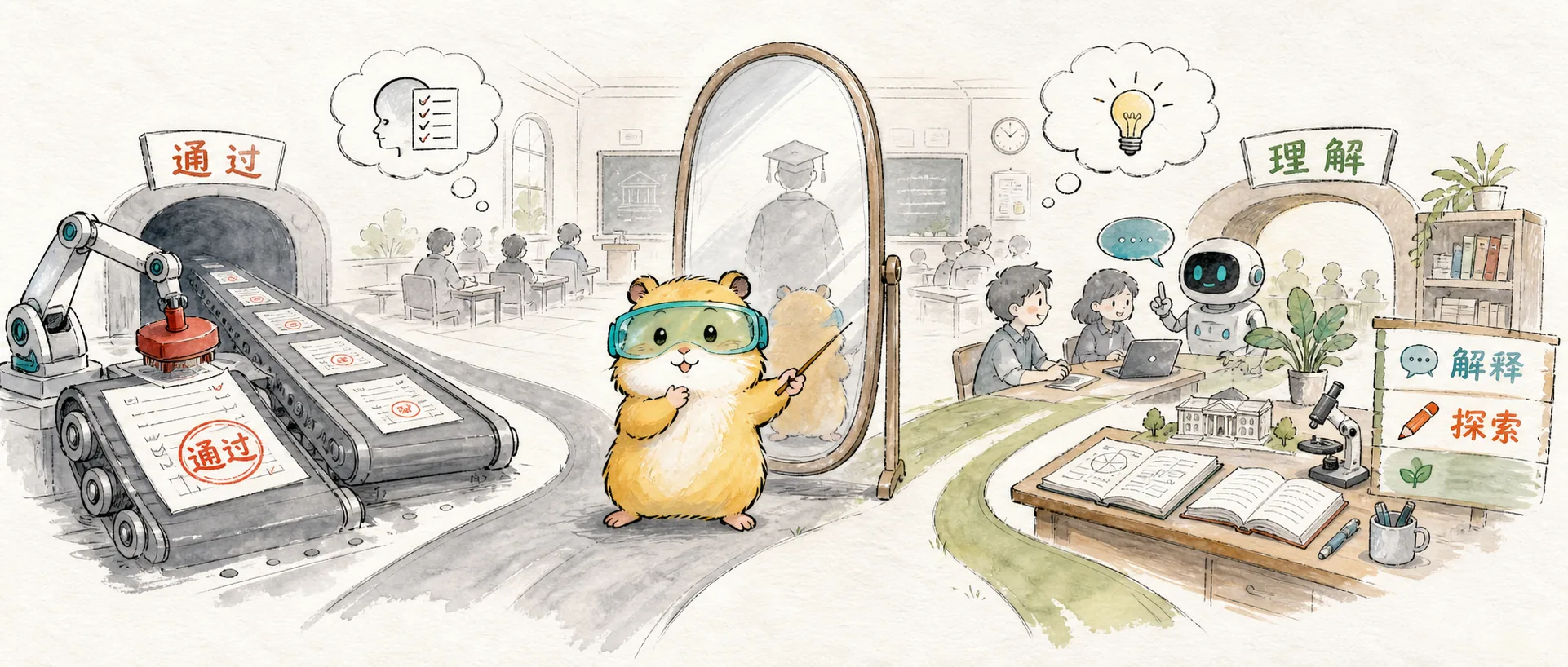
When AI Can Help You Pass Without Studying, What's Left of College?
90% of college students use AI, but that's just the surface. The real question: AI is exposing a fundamental contradiction in education — when knowledge is no longer scarce and exams can be bypassed by technology, what's the meaning of learning itself?
Anthropic recently produced an interview featuring four students from Princeton, Berkeley, the London School of Economics, and Arizona State University, discussing the real state of AI on campus. The nearly 40-minute conversation had no marketing speak — just genuine confusion, anxiety, and reflection.
This interview reveals a deeper issue: AI isn't just changing how we learn — it's dismantling the underlying logic of the entire education system.
An Unavoidable Reality
The interview opens with a direct question from the host: What's the current campus atmosphere around AI?
The answer: 90% of students are using AI. Not occasionally, but as part of their daily workflow — summarizing lecture notes, answering problem sets, getting homework feedback, analyzing business cases, conducting market research, completing financial studies. Some students even use it for quizzes, and the reasoning is practical: when you're a graduate student juggling multiple jobs, you don't always have the time.
But what's more interesting is that while almost everyone is using it, nobody knows the rules. Some courses explicitly ban AI, some actively encourage it, and most exist in a gray area. Students don't know where the line is, and professors don't know how to enforce it. This state is called the "gray zone" — wanting to use it but fearing violation; not using it but feeling left behind.
The most dangerous thing about this gray zone isn't that students might violate rules — it's that it prevents truly valuable discussions from happening. Students can't openly share AI best practices, professors can't guide students on responsible tool usage, and the entire academic community falls into an awkward state of surface-level prohibition and private use.
When rules can't be effectively enforced, they become a tool for filtering "those who can disguise their usage" from "those who can't." A state of explicit prohibition but widespread private use won't stop students from using AI — it will only stop them from openly discussing how to use it better.
AI Is a Mirror
One observation from the interview is particularly sharp: artificial intelligence, and especially how students use it, is very revealing of their motivations.
The insight behind this statement: AI has become a mirror, reflecting your real purpose for attending college.
The interview categorizes university goals into three types: first, deep learning of specialized knowledge and gaining profound understanding of a field; second, career preparation — finding good jobs and building professional networks; third, expanding social connections, enjoying campus social life, and experiencing university culture. Every student weighs these three goals differently, and their AI usage precisely exposes these weightings.
If you only care about "passing exams" and "getting the degree," you'll submit AI output directly as your assignment. This isn't a moral judgment — it's reality. When technology lets you achieve your goal with minimal cost, why take the longer route? If your goal was always to get a degree for a job, using AI to complete assignments is an entirely rational choice.
But if you genuinely want to learn, to deeply understand a field, you'll use AI as a conversation partner. You'll ask it questions, have it explain concepts, then rephrase in your own words. You'll have it write a first draft of code, then refactor and optimize it yourself. You'll ensure that at every step, you truly understand what's happening.
This divergence exists not only between different students but between different majors. Humanities students tend to opt out of AI because their learning requires close reading — carefully reading original texts, savoring linguistic nuances, understanding authorial intent. AI undermines this process because it provides summaries and paraphrases, not direct experience of the original text. Engineering and business students heavily use AI because it lowers technical barriers, enabling people without computer science backgrounds to write code, build websites, and analyze data.
This polarization is fundamentally about different understandings of "what's worth learning." For humanities students, the experience of reading Shakespeare in the original is itself the learning; for engineering students, what matters is whether you can solve the problem, not whether you personally wrote every line of code. AI makes this difference more pronounced.
Tool or Crutch? A Simple Litmus Test
A key question in the interview: How do you distinguish whether AI is a tool or a crutch?
The students' answers were remarkably consistent: whether you can explain it.
If you can't explain what you created, can't articulate what role AI played in it, then it's a crutch. If you can explain it as if to a fifth grader, can provide both low-level and high-level explanations, then it's a tool.
This standard seems simple, but it touches the essence of learning. The core logic of the Feynman technique is: if you can't explain a concept in simple language, you haven't truly understood it. Learning in the AI era follows the same principle — if you can't explain what AI did for you, then you're "outsourcing thinking," not "augmenting thinking."
The interview mentions an interesting example: a student developed a tool that takes lecture slides as input, and the AI generates professor-like annotations beside each slide. The student said: "It works well because I've already prompted it to know what I want to learn — definitions of certain things on the slides. Slides are sometimes abstract, lacking background information, and need context added alongside them."
The key is "I've already prompted it to know what I want to learn." This student knows exactly where their knowledge gaps are, knows what kind of help they need, then actively guides the AI to provide it. That's a tool. If they had just thrown the slides at AI saying "summarize this lecture for me" and memorized the output, that would be a crutch.
The difference is agency and understanding. Tool users know what they're doing and control the entire process. Crutch users hand control to the technology and become passive receivers.
Schools Aren't Just Slow — They're Fundamentally Unable to Cope
The interview mentions some institutional attempts. An LSE mandatory course began teaching students how to use Claude — conversing with it, assigning it different roles, then requiring students to submit conversation logs showing how they interacted with the AI. Arizona State University's career center built a prompt library providing prompt templates for different scenarios. These are good attempts, with the core idea being: don't ban AI, teach students to use it responsibly.
But these are the minority. Most schools are still debating "should students be allowed to use AI." Some professors say yes but require disclosure; some courses ban it outright; others simply don't address it, defaulting to assuming students won't use it. No integration framework, no unified standards — the entire system is in chaos.
The deeper issue: this problem fundamentally cannot be solved through regulations.
Traditional education's regulatory logic is: schools set rules, students follow rules, violators get punished. This logic requires "violations can be detected." But AI breaks this premise.
You can ban students from using AI when submitting assignments, but you can't monitor whether students used AI during their thinking process. You can use AI detection tools, but their accuracy is far from sufficient to serve as a basis for punishment — false positive rates are too high, and students quickly learn to bypass detection. More importantly, fundamentally, you cannot distinguish between "high-quality work completed with AI assistance" and "high-quality work completed independently," because good AI usage should be seamless.
One quote from the interview is blunt: fundamentally, no policy is going to change the way that students use AI. The onus is on the students. This isn't passing the buck — it's reality.
When technology makes "passing exams without studying" possible, schools face not a management problem but an existential one: if exams can't prove learning, what's the point of school?
The Underlying Logic of Education Has Broken
This question touches the fundamental contradiction of the education system.
Traditional education rests on several core assumptions: first, knowledge is scarce and requires specialized institutions (schools) and professionals (professors) to transmit it; second, learning outcomes can be measured through exams; third, degrees prove you've mastered knowledge in a field, qualifying you for related work.
AI is breaking these assumptions one by one.
Knowledge is no longer scarce. YouTube has free Stanford courses, Claude can answer your questions anytime, and GitHub has countless open-source projects to learn from. You don't need to attend school to access knowledge, and you don't even need a paid subscription for basic AI tutoring.
Exams can't measure learning. When AI can complete most exam questions, exams shift from "tools measuring understanding" to "tools measuring whether you can use AI." This doesn't mean exams are entirely useless, but they can no longer accurately distinguish between "someone who truly learned" and "someone who knows how to use tools."
The value of degrees is declining. When employers realize degrees can't guarantee candidates actually mastered relevant knowledge, they'll place more weight on demonstrated ability — portfolios, project experience, internship performance. Degrees are downgraded from "proof of competence" to "baseline entry requirement."
When these assumptions break, the education system's value proposition needs redefinition.
The interview offers an answer: the value of college shifts from "transmitting knowledge" to "providing an environment." An environment where you can make mistakes, explore, and bounce ideas off others. You can spend weekends with roommates on a "bucket list before graduation," test "probably stupid" ideas at hackathons, argue with professors, discuss with classmates, and learn from failure without risking your career.
Student projects mentioned in the interview illustrate this well — "automated course registration alerts," "empty classroom finders," "graduation bucket list leaderboards." None are technically complex; many creators don't even have computer science backgrounds. But they spring from genuine human emotions: fear of missing out, pursuit of convenience, cherishing university life.
When technical barriers drop, what matters is no longer "can you code" but "what problem do you want to solve." College provides a space for freely exploring these questions, an environment for turning ideas into reality and learning from failure.
AI can complete your assignments, but it can't live through this time of "making mistakes and exploring" for you.
The Employment Market Paradox
The latter part of the interview touches on employment, revealing another paradox.
Students use AI to write resumes, companies use AI to screen resumes. The entire hiring cycle becomes talking to screens — first using AI to write cover letters, then answering questions on video, finally receiving AI-generated rejection letters. From resume submission to rejection, it might take just 15 minutes. Very efficient, but very little humanity.
This creates an "AI vs AI" job market. Students train AI to write "good" resumes, companies train AI to screen "good" candidates. Real humans play an increasingly small role. There's no chemistry in talking to a screen, no way to showcase qualities that are hard to quantify but deeply important — humor, adaptability, the subtleties of teamwork.
But the flip side of the paradox: AI proficiency itself has become a new competitive advantage. The Big Four consulting firms used to recruit generalist MBAs; now they specifically look for AI-capable MBAs. If you know how to apply AI across different industries, you're their top candidate.
The paradox: AI makes the job market colder while simultaneously making it value AI skills more. You can't escape it — you can only learn to use it effectively.
This circles back to the core question: what does "effective use" mean? Not using ChatGPT to write emails, but being able to identify which problems are suited for AI, design prompts to guide AI toward the results you need, and evaluate AI output quality while making necessary corrections.
This capability isn't developed by banning AI, but through extensive practice and trial and error. This is also why schools that proactively embrace AI — building Claude Builder Clubs, organizing hackathons — are providing more valuable education. They're letting students learn to collaborate with AI in a relatively safe environment.
The Transfer of Responsibility
Perhaps the interview's most core insight is this: when technology enables you to "pass exams without studying," the meaning of learning itself becomes a question each person must answer for themselves.
This is a transfer of responsibility. From school to student, from rules to self-discipline, from external motivation to internal motivation.
Traditional education's motivation is external: you need to pass exams to get a degree, and you need a degree to get a job. This external incentive system drives students to learn. But when AI lets you pass without studying, this incentive system fails.
What remains is only internal motivation: Do you genuinely want to learn? Are you truly interested in this field? Do you really want deep understanding, or just a degree?
There's an interesting detail in the interview. A student mentions the downside of graduate school — you're juggling multiple jobs, running out of time, so sometimes you use AI to quickly complete quizzes. But then they add: grad school is supposed to be a period where you expand your critical thinking, where you demonstrate a more decisive side. They recognized the contradiction but chose efficiency.
This isn't moral judgment. Under real-world pressure, efficiency often trumps ideals. But this choice reveals a fact: when external pressure (completing quizzes) conflicts with internal motivation (deep learning), many people choose the former.
AI makes this conflict sharper because it makes "getting through exams" extremely easy. In the pre-AI era, even if you just wanted to get through exams, you still had to learn something to pass. AI removes this intermediate step — you can pass without learning at all.
This forces everyone to confront the question: Why are you actually in college?
If the answer is "to get a degree for a job," then using AI to complete assignments is perfectly reasonable. If the answer is "I genuinely want to learn this field," then you need to actively resist the shortcut temptation that AI brings.
Schools can't make this choice for you. Rules can't force you to develop internal motivation. This is your own responsibility.
Technology Won't Wait for You to Be Ready
A persistent attitude runs through the interview's conclusion: "We'll figure it out."
School rules can't keep up? Start using it first, then tell schools what works. AI might be used for cheating? Gradually learn to use it responsibly. Job market changed? Adapt to the new rules of the game.
This isn't blind optimism — it's realism. Technology is already here, and it won't wait for you to be ready before changing the world. You can choose to resist or adapt, but you can't choose to stop time.
This generation's relationship with AI isn't fear, isn't blind embrace — it's feeling their way through chaos, learning through trial and error.
The projects they're building in Claude Builder Club — not technically complex, but solving real problems. The ideas they're testing at hackathons — maybe silly, but at least they're trying. Their confusion in classrooms — rules aren't clear, but at least they're thinking.
This attitude of "learning by doing" might help them adapt to the AI era better than any set of regulations.
Kevin Kelly proposed the "technium" concept in What Technology Wants: technology as a whole seems to have its own will, wanting to become ever more powerful. An observation from the interview echoes this: over the past two years, whatever AI needed to continue developing, it got. Shifts in attitudes toward nuclear energy, discussions about space data centers — whenever a bottleneck might slow AI, the obstacle gets removed.
But a more accurate framing might be: students create whatever they need.
AI is just a tool. What determines the future is how this generation of students chooses to use it — to avoid thinking or augment it. To get through exams or explore the world. As a crutch or as a tool.
This is a choice schools can't control — only they can decide for themselves.
And from this interview, at least some students are seriously thinking about it. That might be enough.
Comments
Agentic Engineering
从高中时期在 NASA JPL 开始写代码、后来创办 HumanLayer 的 Dex Horthy,在这场访谈里解释为什么 Coding Agent 越快,软件交付的瓶颈越会转向程序设计、验证与长期维护。
Think Like an Agent: Claude Code Team's Tool Design Philosophy
Insights from Anthropic engineer Thariq on agent tool design — from three failures to progressive disclosure, how the Claude Code team learned to see like an agent.